

Whether your child is unhappy splashing on holiday or refuses formal lessons, it is essential to explore the underlying reasons. Below, we look at why your child might be struggling and how you can help them enjoy the water.
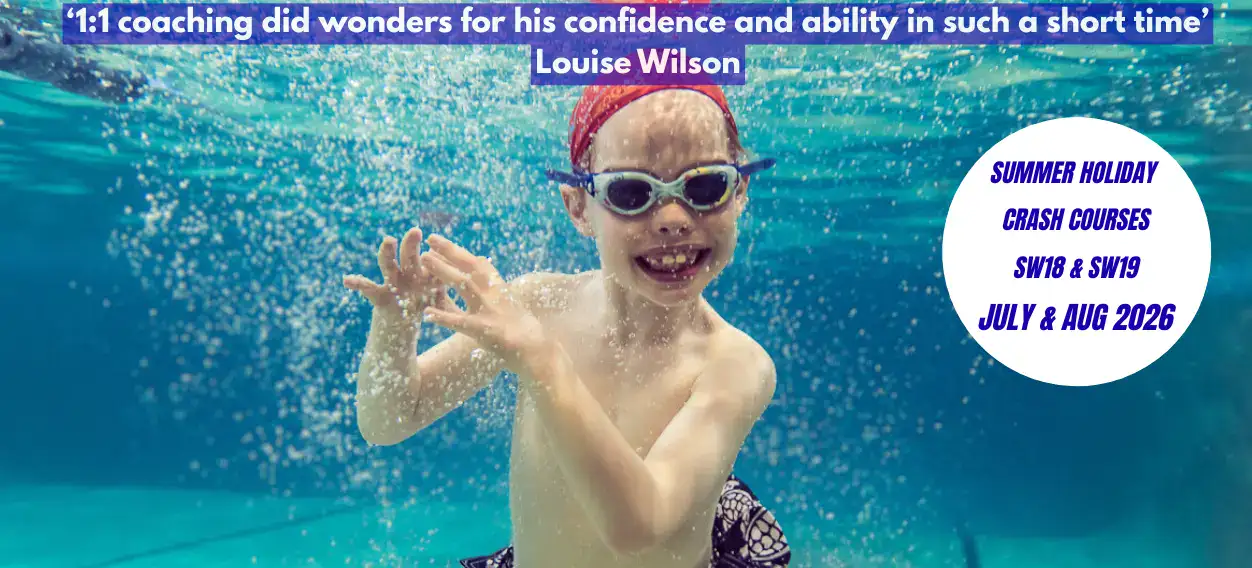
🚀 Summer Holiday Breakthrough: July & August 2026
Is your child stuck in a cycle of “swimming refusal”?
Sometimes, a weekly 30-minute group class is simply too loud, chaotic, and overwhelming for a nervous child.
Our premium 1:1 Summer Holiday Crash Courses in Wimbledon (SW19) and Southfields/Wandsworth (SW18) provide a quiet, low-distraction environment. Over 5 consecutive days, your child builds deep trust with the same dedicated coach, helping them overcome fear and correct strokes rapidly.
We regularly welcome families from across Putney, Fulham, Kingston, and Wandsworth.
📍 Quick Travel Times to Our Quiet Private Pools:
Skip the busy, echoey leisure centres. Our 1:1 summer crash courses run in warm, low-distraction environments that are easily accessible for families across Southwest London:
- Wandsworth & Southfields (SW18): Located right at the Aspire Centre. Your premium local training hub.
- Wimbledon (SW19): Based at Wimbledon College. Ideal for SW19 local families.
- Putney (SW15): A direct 10-minute drive down Merton Road or a quick trip over Putney Bridge to our SW18 pool (free on-site parking).
- Fulham (SW6): Drive straight over the river or take the District Line directly to Southfields Station.
- Kingston (KT1/KT2): A straightforward drive up the A3 directly to our Wimbledon College pool (SW19) with easy private parking.
 What Are The Reasons for Your Child Refusing Swimming Lessons?
1) Fear of Water
Early, fun exposure through toddler swimming helps form a healthy connection with the pool. Fear is often caused by a previous negative experience or a family history of water anxiety.
2) Separation Anxiety
Common in children aged 1 to 4, younger swimmers may feel uneasy being apart from their parents in a new environment.
3) Sensory Overload
Bright lights and loud noises can be overwhelming, especially for children with ASD or Sensory Processing Disorder (SPD).
4) Physical Discomfort
Pool temperature (ideally around 29°C) and air temperature are vital. Ill-fitting goggles or cold water can quickly trigger negative emotions.
5) Lack of Confidence
Children may feel intimidated in group lessons if they feel others are more advanced, leading to a fear of embarrassment.
6) Peer Pressure and Geography
In areas like Wimbledon, Putney, and Kingston, many children are confident swimmers by age 7 due to early school swimming. If a child feels “behind” their peers, they may refuse to go to avoid shame. An intensive Summer Crash Course is often the best way to help them “catch up” quickly in a private setting.
7) Teaching Style
Some children don’t thrive in large groups and require the focused attention of private or semi-private lessons to feel safe.
Understand Your Child’s Water Anxiety
Lack of water confidence is the most common reason for refusal. Watch for these signs:
- Clinginess: Holding onto the parent or poolside at all times.
- Submersion issues: Refusing to get their face or head wet.
- Goggle reliance: Panic if water touches the eyes.
- Deep water panic: Refusing to go where they cannot touch the bottom.
How to Overcome the Fear of Swimming
- Start Young: Parent and Child classes are the best way to build trust before age 3.5.
- Transition Slowly: If a pre-schooler struggles with separation, 1:1 lessons provide the security they need to bridge the gap.
- Intensive ‘Reset’ Courses: For school-aged kids (5–10) who are stuck, a 5-day intensive crash course provides more progress than 4 months of weekly lessons. It creates a “safe bubble” to master skills without peer distraction.
Tips for Family Swims
- Choose warm pools and stay in the shallow end.
- Use toys and sinkers to make the experience joyful.
- Avoid goggles initially to encourage natural water comfort.
- Be patient—celebrate small wins like splashing.
- Switch from Group Lesson to Private Lessons.